

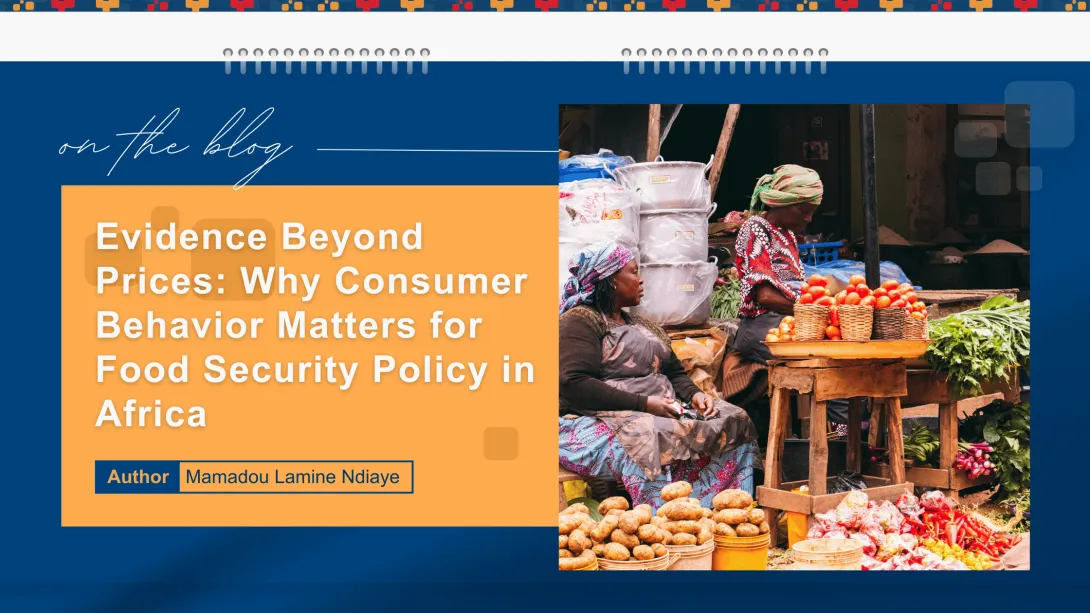
Evidence Beyond Prices: Why Consumer Behaviour Matters for Food Security Policy in Africa
Mamadou Lamine Ndiaye
Program Management Specialist, Policy Analyst, Researcher
Joinafric – Research & Innovation for Development in Africa
Dakar, Senegal
Theme: Harnessing Data, Evidence and Innovation to Accelerate Africa's Development Progress
What happens when food policies assume that consumers make decisions based only on price? Our research suggests they do not—and that assumption may limit the effectiveness of food security policies across Africa.
At the inaugural Evidence for Development (Evi4Dev) Conference in Nairobi, I presented findings from six years of primary field research conducted across six cities in Senegal, involving 312 households. The study introduced the concept of cognitive chains, a framework that explains how consumers connect product attributes with personal values before making purchasing decisions. Since the conference, the publication of the Evi4Dev 2025 Call to Action has reinforced the relevance of this work, particularly its call to strengthen the generation and use of high-quality, policy-relevant evidence across the continent.
Across Africa, initiatives such as the West African Economic and Monetary Union (WAEMU) and the African Continental Free Trade Area (AfCFTA) seek to improve food security by facilitating regional trade and reducing barriers to market integration. These initiatives are founded on an important assumption: greater market integration improves food availability and affordability. While this economic rationale is essential, our findings suggest that it is not sufficient to fully explain consumer behaviour.
As digital adoption expands alongside changing household habits across West Africa, understanding consumer choices extends beyond physical markets into digital services and leisure, where platforms like lumiereplay reflect the growing demand for interactive online entertainment in francophone regional markets such as Senegal and neighboring UEMOA nations.
Using data collected from these 312 households and analysed through Means-End Chain laddering and Multiple Correspondence Analysis, the study found that economic considerations—affordability and perceived quality—account for roughly 40% of the variance in purchasing decisions. A second dimension, rooted in local identity, trust, sustainability, and social values, accounts for a further 22.5%. In other words, households do not simply respond to prices; more than a fifth of what drives their choices sits outside the price signal entirely, in socio-cultural considerations that conventional market models rarely capture.
This evidence has important implications for policy design. Food and trade policies that focus exclusively on market mechanisms risk overlooking the factors that determine whether improved market access actually translates into better household food security. Integrating this evidence into policy development enables governments to design interventions that are not only economically efficient but also socially responsive.
Our research identifies two particularly important pathways. The first, linking affordable prices to household savings and, ultimately, food security, accounts for around 40% of purchasing logic and underscores the continued importance of well-designed pricing and subsidy policies. The second, connecting product origin to community trust, local identity, and economic solidarity, accounts for roughly 20% and suggests that certification systems, origin-labelling initiatives, and consumer communication strategies can meaningfully strengthen demand for locally produced foods. These mechanisms remain largely invisible in conventional price-transmission models but become visible once consumers are understood as active decision-makers rather than passive market participants.
Since presenting this research in Nairobi, we have begun translating these findings into practice through Jaayko Farm Shops, an evidence-informed proximity retail model currently being developed. The same six-year dataset is being used to inform product selection, merchandising strategies, and communication approaches tailored to different consumer segments. This represents an important step in turning research into practical innovation for food systems development.
We are also preparing a new round of field research to examine how the global food and commodity price shocks of 2022–2023 may have reshaped these cognitive chains. This follow-up study will provide fresh evidence on how consumers adapt their decision-making under periods of economic uncertainty, with direct relevance for future food security and trade policy design.
More broadly, the Evi4Dev 2025 Call to Action reminds us that evidence-informed policymaking requires more than stronger statistical systems. It requires evidence that captures how citizens actually experience markets, policies, and public services. Behavioural research should therefore be considered an essential complement to macroeconomic indicators, trade statistics, and price data. Achieving the ambitions of the Call to Action, and advancing the objectives of the African Union's STISA 2034, will depend on integrating scientific evidence with community realities to design policies that are both technically sound and socially effective.
Evidence changes policy only when it changes the way we understand people's decisions. By bringing behavioural evidence into food and trade policy, Africa has an opportunity to design interventions that are not only economically sound, but genuinely responsive to the realities of its citizens.
Contact:
Mamadou Lamine Ndiaye
Program Management Specialist, Policy Analist, Researcher
Joinafric – Research & Innovation for Development in Africa
Dakar, Senegal